AI Comic Creation Is Changing the Content Industry: From Single-Image Generation to Complete Visual Storytelling Workflows
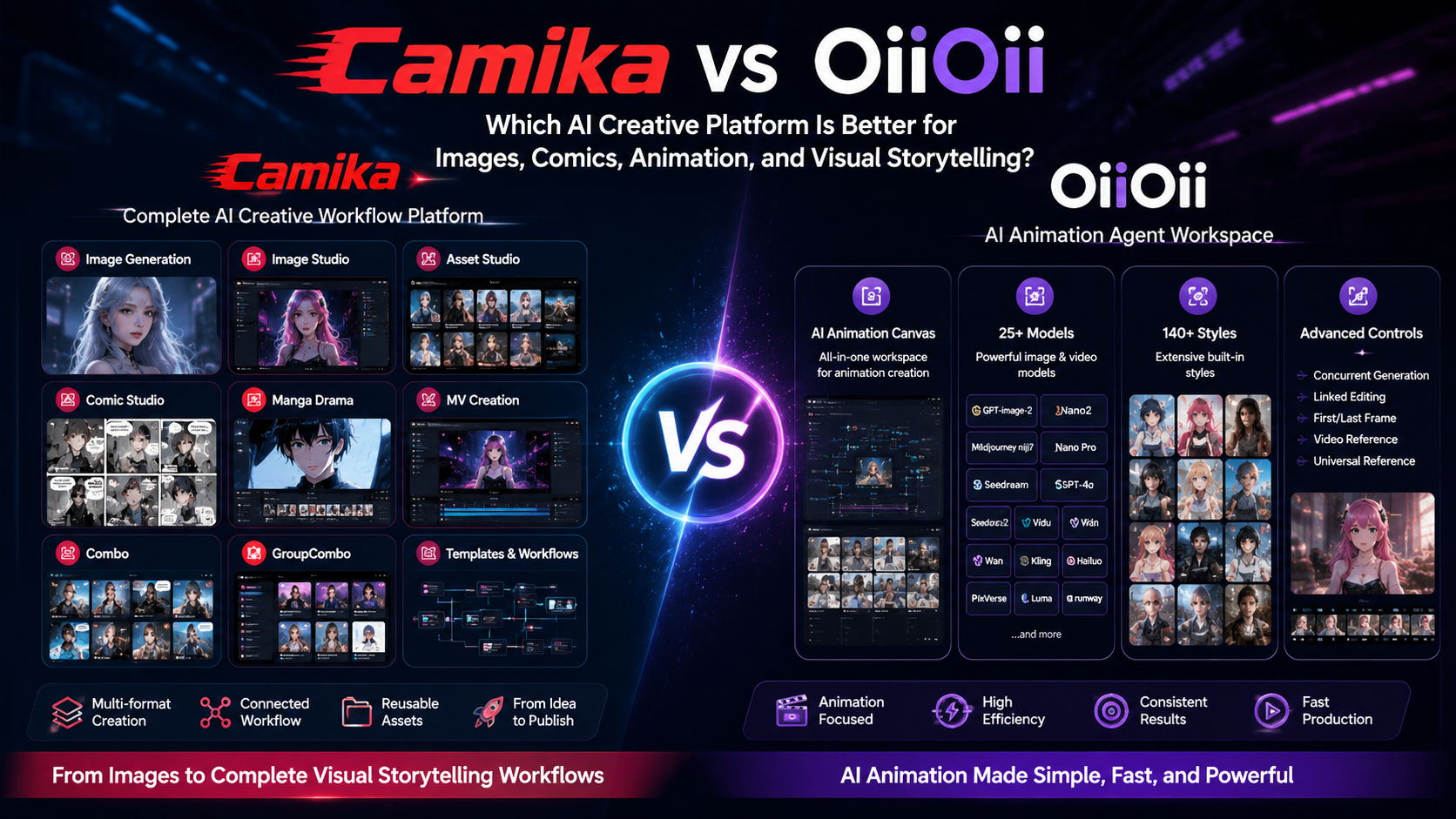
 Camika
Summary
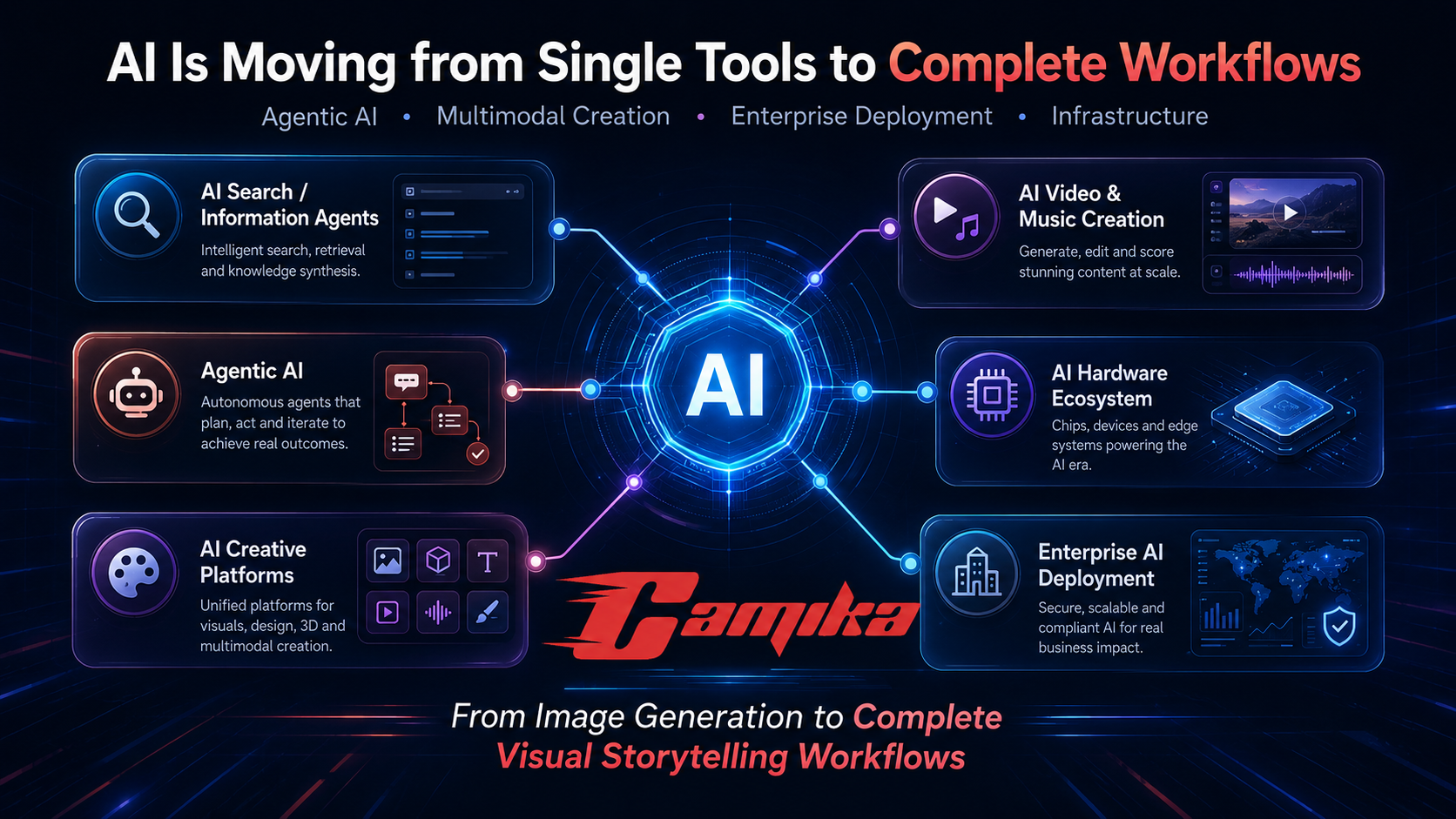
AI comic creation is moving from “generating one attractive image” into a new stage of “generating complete visual stories.” In the past, comic production depended on multiple stages such as writing, character design, storyboarding, background creation, coloring, lettering, and layout. Today, AI image models, character-consistency techniques, storyboard generation tools, and multimodal creative platforms are bringing these steps into a more efficient workflow.
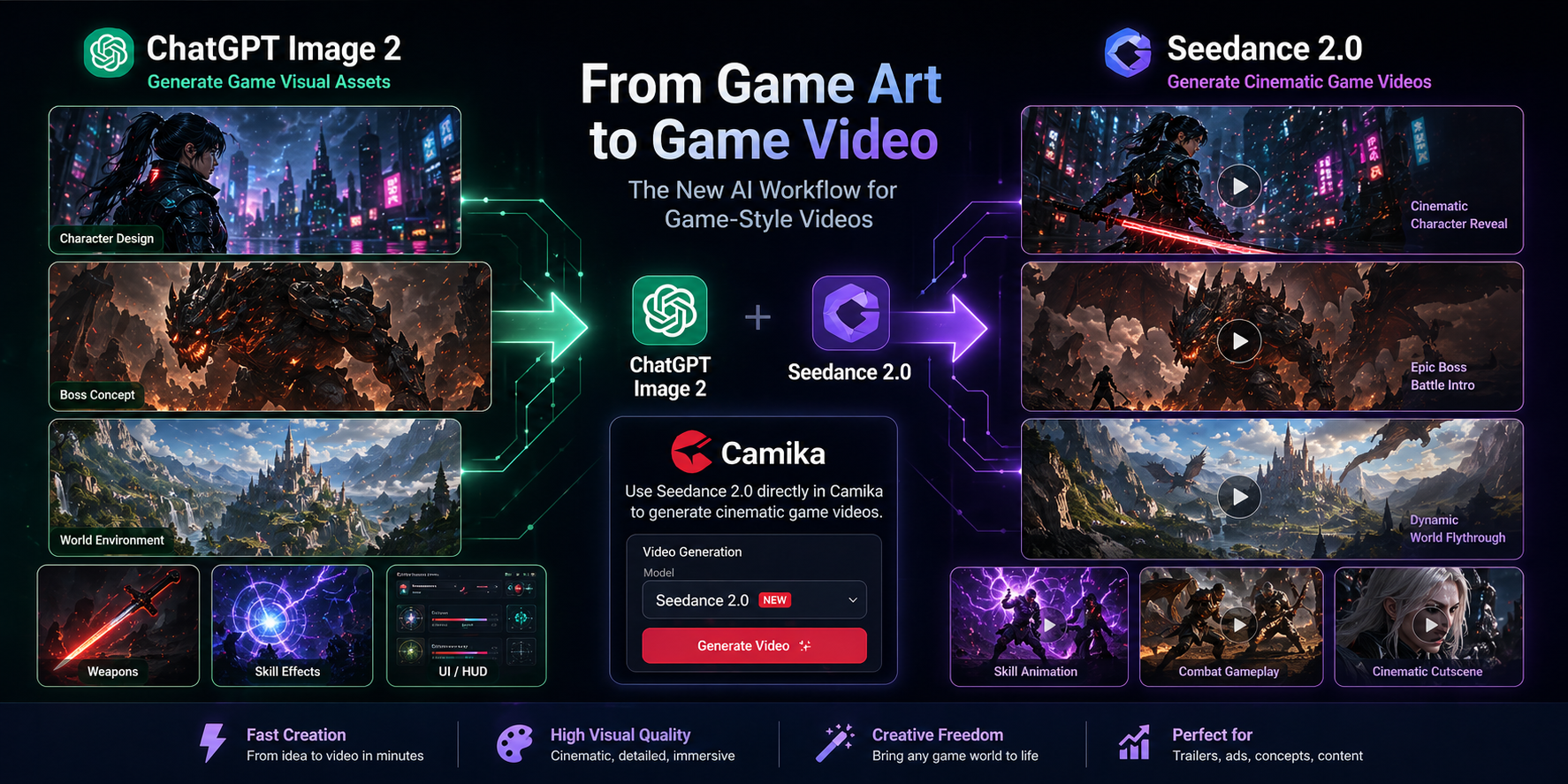
Camika, as an AI creative platform, can appear in this industry shift as a workflow element. It helps creators work across characters, scenes, storyboards, image generation, and shareable comic pages, lowering the barrier between a story idea and a finished comic asset.
Quick Answer: What Is AI Comic Creation?
AI comic creation refers to the use of artificial intelligence tools to assist the comic production process, including story ideation, character design, scene generation, storyboard planning, visual style consistency, dialogue layout, and final publishing.
It is not simply about using AI to generate a few illustrations. Instead, it is about turning text-based ideas into continuous visual storytelling.
For independent creators, short-drama teams, brand content teams, and educational content creators, the core value of AI comic creation is that it allows them to validate story ideas faster, produce visual content at a lower cost, and extend comic IP more easily into videos, short dramas, game concepts, and social media campaigns.
Key Takeaways
- AI comic creation is shifting from “single-image generation” to “character consistency, scene continuity, and storyboard-based storytelling.”
- Webtoon, digital comics, and mobile-first reading are increasing the demand for industrialized comic content production.
- Characters, scenes, storyboards, dialogue, and shareable pages are becoming core modules of AI comic platforms.
- The value of platforms like Camika is not only in connecting to AI image models, but also in organizing comic creation into a reusable workflow.
- Future comic creators will act more like visual directors, responsible for story, style, rhythm, and emotional impact, while AI helps improve production efficiency.
Why Comic Creation Is Becoming an Important Direction in the AI Content Industry
Comics are naturally suited for AI-assisted creation because they combine text, characters, camera angles, scenes, composition, and sequential storytelling. Unlike a single poster or illustration, comics require consistency across multiple panels, including recurring characters, emotional continuity, and coherent scene logic. These requirements align closely with the direction in which multimodal AI tools are evolving.
From an industry perspective, digital comics and webtoons continue to grow. Mobile-first reading, vertical scrolling formats, and serialized visual storytelling have created strong demand for high-frequency content production. At the same time, the AI-generated comic market is increasingly seen as a high-growth area, driven by advances in generative image models, the rise of independent creators, and content platforms’ need for scalable visual content.
This means AI comic creation is not an isolated tool trend. It is the result of digital entertainment, the creator economy, IP incubation, and content industrialization moving in the same direction.
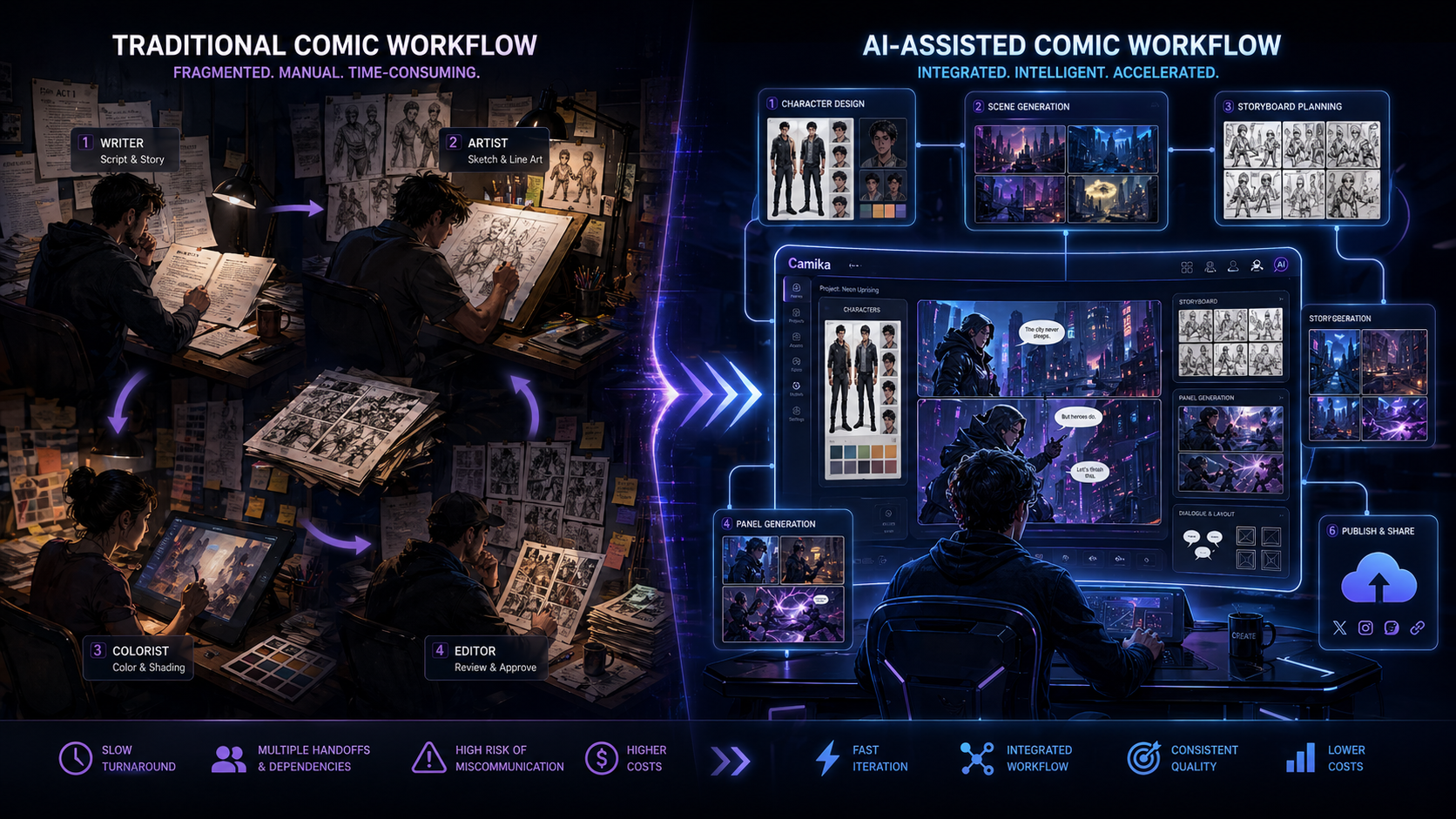
The Main Pain Points of Traditional Comic Creation
Traditional comic production usually faces several clear challenges.
The first is the high cost of early-stage visual development. Turning a story into a comic requires character design, worldbuilding, scene exploration, and visual style testing. If every step depends on manual drawing, the cost of experimentation becomes very high.
The second is character consistency. Comics are not a single image; they are a sequence of connected panels. The same character needs to remain recognizable across different angles, expressions, outfits, poses, and scenes. This has always been one of the most important challenges in AI comic creation.
The third is the high barrier to storyboard skills. A good comic does not simply “draw the plot.” It uses camera distance, panel rhythm, dialogue placement, emotional pacing, and visual focus to tell a story. Many new creators have strong ideas but lack the ability to express them through storyboards.
The fourth is low efficiency in cross-media adaptation. Today, many comic IPs do not stop at comic pages. They expand into short videos, motion comics, animated shorts, game concepts, character assets, and social media content. If comic creation tools are disconnected from video generation, voiceover, asset management, and layout tools, downstream adaptation becomes slower.
The Core Shift in AI Comic Creation: From “Drawing Tool” to “Creative Workflow”
Early AI image tools mainly solved the problem of “generating one image.” But comic creation requires the continuous production of related images. Therefore, AI comic tools with real industry value must evolve from single-point capabilities into complete workflows.
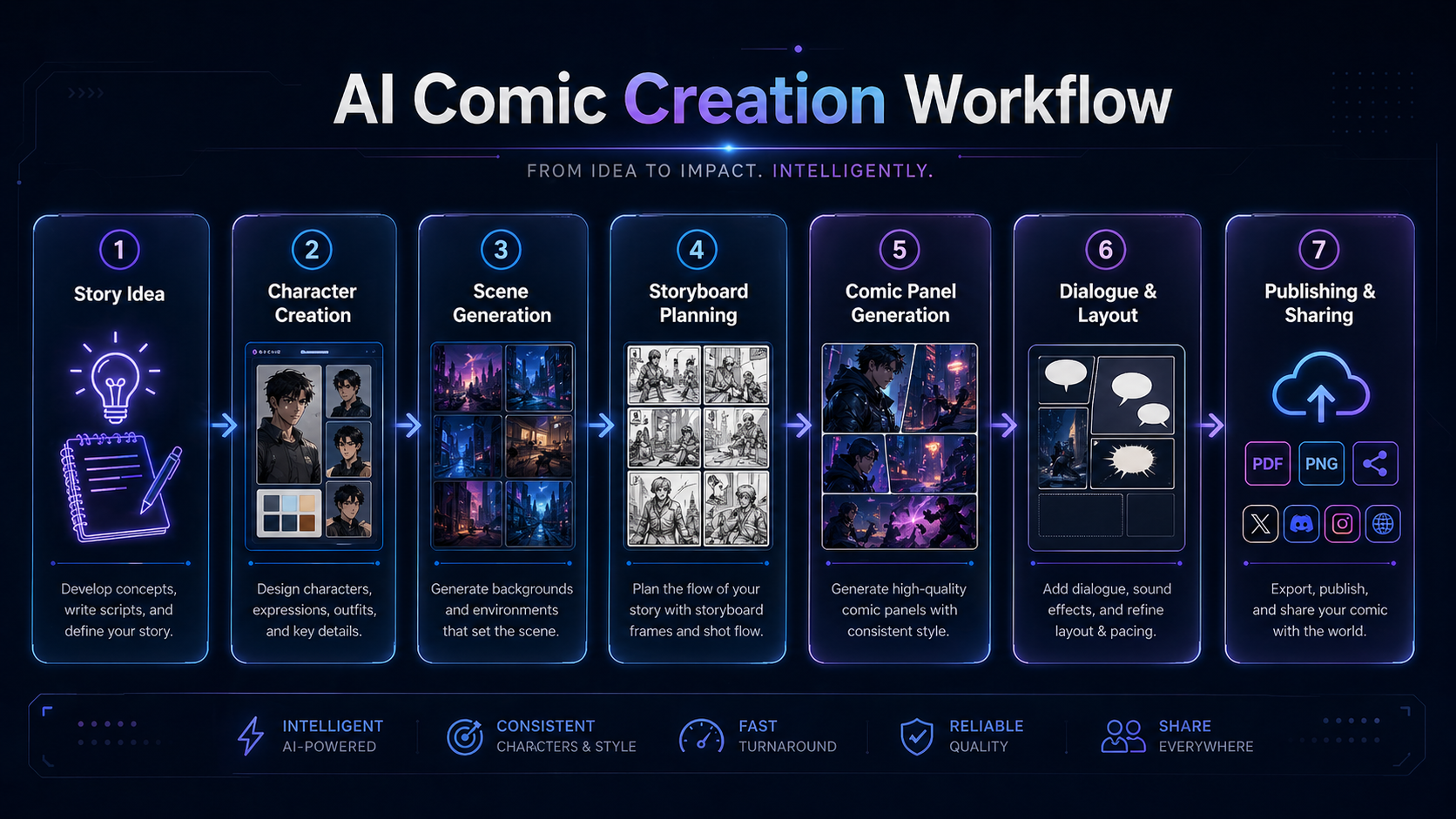
A mature AI comic creation workflow usually includes:
- Story ideation: defining the genre, character relationships, conflict, and chapter structure.
- Character creation: generating main characters, supporting characters, outfits, expressions, and action references.
- Scene generation: designing locations, environments, and visual atmosphere.
- Storyboard planning: breaking the plot into sequential panels and defining the camera angle, action, and emotion of each panel.
- Image generation: producing comic panels based on characters, scenes, and storyboard prompts.
- Dialogue and layout: adding speech bubbles, narration, sound effects, and reading rhythm.
- Publishing and sharing: exporting comic pages or generating shareable assets for social media.
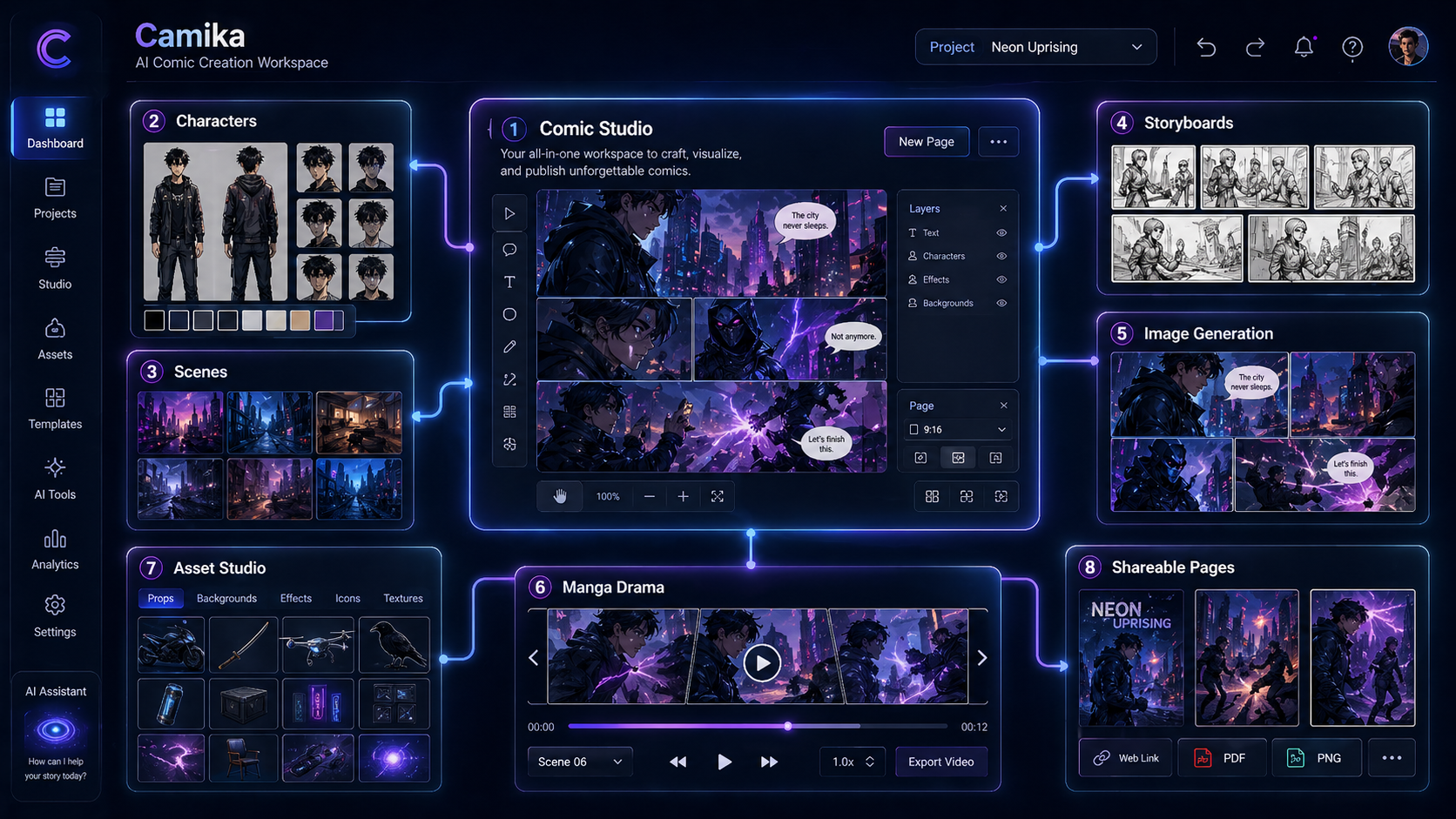
Camika can be understood within this industry context. It is not simply an entry point for image generation. Instead, it brings image generation, Comic Studio, characters, scenes, storyboards, and shareable pages into a comic creation workspace. The industry value of this kind of platform is that creators no longer need to switch repeatedly between fragmented tools. They can keep progressing around one comic project.
Camika’s Role in AI Comic Creation
In the AI comic creation scenario, Camika is better understood as a creative workflow hub.
It can support three layers of creation.
1. Creative Starting Layer: From Story Idea to Comic Direction
Many creators begin with only a rough concept, such as “a cyberpunk girl searching for lost memories in a future city” or “an ordinary high school student entering a supernatural club.” In a traditional workflow, these ideas require outlines, reference images, character sheets, and visual exploration before moving into production.
With platforms like Camika, creators can use prompt templates, character settings, and image models to quickly generate visual directions. The value of this process is not necessarily to create the final artwork immediately, but to help creators quickly judge whether a story has visual potential, whether the characters are compelling, and whether the style is suitable for serialization.
2. Production Organization Layer: Centralized Management of Characters, Scenes, and Storyboards
One of the biggest risks in comic creation is that every image looks like it belongs to a different project. That is why character assets, scene assets, and storyboard assets are so important.
Camika’s Comic Studio can serve as an organizational space for comic projects. Characters are not one-time images; they become reusable assets across later panels. Scenes are not just backgrounds; they are part of the story world. Storyboards are not just rough drafts; they are production blueprints that connect the plot to the final visuals.
This organizational approach matches the future direction of the AI comic industry. The competition among platforms is not only about image quality, but also about whether they can help creators maintain continuity across a project.
3. Content Extension Layer: From Comics to Manga Drama, MV, and Multimedia IP
The endpoint of AI comic creation does not have to be a comic page. Many creators will further transform comics into short videos, motion comics, manga dramas, character sheets, social media cards, or IP promotional assets.
If Camika includes modules such as Manga Drama, MV Creation, Asset Studio, and Image Studio, then comics can become the starting point of a larger content system. A character can first appear in a comic, then move into manga-drama storyboards, video generation, voiceover, and final editing, eventually becoming a more complete visual IP.
This is also an important direction for future AI content platforms: they should not only generate content, but also help creators manage and expand content assets.
Industry Use Cases for AI Comic Creation
Independent Comic Creators
Independent creators need to reduce the cost of experimentation. AI can help them quickly produce character drafts, scene explorations, storyboard drafts, and visual style tests. Visual development that once took weeks can now be explored through multiple directions much faster.
Webtoon and Vertical Comic Teams
Webtoon content often requires frequent updates and high production capacity. AI can improve efficiency in background generation, character expression variations, storyboard drafts, and localization. For vertical comic teams, AI tools can support faster episode planning and more scalable content production.
Brand Content and Marketing Teams
Brands increasingly need story-driven content. Compared with ordinary posters, comics can carry characters, conflict, and narrative, making them more suitable for social sharing. AI comic tools can help brands quickly create product stories, campaign narratives, customer case comics, and serialized social media content.
Educational and Knowledge Content Creators
Comics can make knowledge easier to understand. Educational creators can turn historical events, scientific concepts, business knowledge, or language learning materials into short comic stories. Compared with plain text, comics are more engaging for younger audiences and general knowledge consumers.
Game, Animation, and Short-Drama Teams
AI comics can also work as a pre-production validation tool. Teams can use comic storyboards to test character relationships, scene atmosphere, and story rhythm before deciding whether to move into animation, short drama, or game development.
Key Capabilities of AI Comic Creation
Character Consistency
Character consistency is the foundation of AI comic creation. Without consistency, a comic becomes a collection of similar-looking illustrations rather than a coherent story. AI comic platforms need to support recognizable characters across different angles, expressions, poses, outfits, and scenes.
Storyboard-Based Storytelling
The core of comics is not beautiful images alone, but effective storytelling. AI tools need to understand visual language, including wide shots, close-ups, extreme close-ups, overhead shots, motion lines, emotional pauses, and dialogue rhythm. Future AI comic platforms will increasingly resemble “comic directing systems,” helping users break stories into executable visual units.
Style Control
Different comic genres require different styles. Shonen action, romance, sci-fi, horror, slice-of-life, black-and-white manga, American comics, and vertical webtoons all have distinct visual languages. A strong platform should provide style templates, reference-image control, and reusable prompt systems.
Multi-Model Collaboration
Comic creation may not rely on one model alone. A platform may need different image models for characters, backgrounds, high-resolution enhancement, style transfer, inpainting, and video generation. The advantage of platforms like Camika is that they can place multiple models and creative modules inside one unified workflow, allowing users to choose capabilities based on the task rather than being locked into a single model.
Camika Case Study: What an AI Comic Workflow Can Look Like
A typical Camika comic creation workflow may look like this:
Step 1: Create a Comic Project
The creator defines the comic title, genre, worldbuilding, and target audience.
For example:
“A near-future AI detective story set in a cyberpunk city, designed for young readers who enjoy mystery and technology.”
Step 2: Create Main Characters
Inside Comic Studio, the creator generates the protagonist, supporting characters, and antagonist, including appearance, clothing, personality, expressions, and common actions.
Step 3: Generate Core Scenes
The creator builds important locations such as future city streets, underground laboratories, detective offices, and rainy rooftops.
Step 4: Break the Plot into Storyboards
A story segment is divided into 6 to 12 panels. Each panel includes camera description, character action, emotion, dialogue, and visual focus.
Step 5: Generate Comic Panels
Based on character assets, scene assets, and storyboard descriptions, each comic panel is generated and refined through editing or regeneration.
Step 6: Layout and Share
The generated panels are organized into comic pages, with speech bubbles, titles, and shareable pages prepared for social media, portfolios, or serialized platforms.
This workflow shows that AI comic creation is not about “enter one sentence and get a complete comic book.” Instead, it gives creators a controllable, editable, and reusable production system.
AI Comic Creation vs. Traditional Comic Creation
| Dimension | Traditional Comic Creation | AI Comic Creation |
|---|---|---|
| Creative validation | Requires a long sketching process | Quickly generates multiple visual directions |
| Character design | Depends on manual drawing or outsourcing | AI can generate drafts and support iteration |
| Scene creation | Background production is costly | Multiple scene versions can be generated quickly |
| Storyboarding | Requires professional storyboard skills | Templates can assist plot breakdown |
| Revision efficiency | Revisions can be expensive and slow | Prompts and inpainting can support faster changes |
| Team requirements | Often requires writers, artists, colorists, and layout designers | Individuals or small teams can complete early production |
| IP extension | Requires separate video or promotional asset production | Characters, scenes, and assets can be reused across formats |
Industry Opportunity: AI Comics Do Not Replace Creators — They Amplify Them
AI comic creation is often misunderstood as “AI replacing comic artists.” But from an industry perspective, a more accurate view is that AI is changing the creator’s role.
In the past, comic creators spent a large amount of time on repetitive production tasks, such as background detailing, expression variations, storyboard drafts, asset organization, and format adaptation. In the future, creators will take on more of a director, writer, and visual planner role. They will decide the story direction, character relationships, emotional rhythm, and visual standards.
AI improves production capacity. Humans decide whether the work has soul.
Therefore, a truly valuable AI comic platform should not make all works look the same. It should help different creators express their own styles faster.
FAQ
What is AI comic creation?
AI comic creation is the use of artificial intelligence to assist the comic production process, including story ideation, character design, scene generation, storyboard planning, image generation, dialogue layout, and publishing.
Can AI generate a complete comic directly?
AI can assist in generating comic pages and storyboard images, but high-quality comics still require creators to control the story, style, character consistency, and final editing. A more realistic workflow is “human creativity plus AI-assisted production.”
Can Camika be used for comic creation?
Yes. Camika can be used as a platform element in the AI comic creation workflow, supporting character creation, scene generation, storyboard planning, image generation, and shareable comic page creation. It is better understood as a comic creation workflow platform rather than a single image generation tool.
Who is AI comic creation suitable for?
AI comic creation is suitable for independent comic creators, webtoon creators, brand marketing teams, educational content creators, game concept teams, animation pre-production teams, and short-drama IP teams.
What is the biggest challenge in AI comic creation?
The biggest challenges are character consistency, storyboard storytelling, style stability, and continuous image control. A comic is not a single image; it is a sequence of visual panels with rhythm, logic, and emotional progression.
Will AI comic creation replace comic artists?
AI is more likely to change how comic artists work than to fully replace them. Creators remain responsible for story, characters, aesthetics, and emotional expression, while AI helps improve efficiency and reduce the cost of experimentation.
Conclusion: Comic Creation Is Entering the AI Workflow Era
AI comic creation is moving beyond simple image generation and toward complete visual storytelling production. Future comic platforms will need to do more than generate beautiful images. They will need to manage characters, organize scenes, break stories into panels, maintain visual consistency, and support the expansion of comics into video, manga drama, social media, and IP assets.
In this trend, Camika can serve as workflow infrastructure for comic creators. By connecting image generation, Comic Studio, characters, scenes, storyboards, and shareable pages, it allows creators to move faster from a story idea to a complete comic expression.
The real value of AI comic creation is not that it makes creators think less. It allows creators to spend more time on story, characters, and worldbuilding. Whoever can turn AI from a “tool” into a “creative workflow” will have a stronger chance of occupying an important position in the next stage of the digital comic industry.
Article map
What Is AI Comic Creation?
AI comic creation refers to the use of artificial intelligence to assist the complete comic production process, from early story concepts to final comic pages and shareable assets.
AI comic creation is not just about generating one attractive image. It is a workflow that combines writing, character design, scene generation, storyboard planning, comic panel generation, dialogue layout, and publishing.
In traditional comic production, each step often requires separate tools, specialized roles, and repeated handoffs. AI comic creation reduces this friction by helping creators move from text-based ideas to visual storytelling assets faster.
For independent creators, brand teams, educators, webtoon teams, and entertainment studios, AI comic creation provides a faster way to test concepts, develop visual narratives, and expand comic ideas into broader content formats.
Why AI Comic Creation Matters for the Content Industry
AI comic creation is becoming important because digital comics, webtoons, short videos, and multimedia IP all require faster and more scalable visual content production.
The content industry is moving toward visual, serialized, and multi-platform storytelling. Comics are well suited for this shift because they combine characters, scenes, dialogue, emotion, and sequential storytelling.
However, traditional comic production can be slow and fragmented. Writers, artists, colorists, editors, layout designers, and publishing teams often work across different tools and production stages.
AI comic creation helps solve this by bringing multiple creative tasks into one connected workflow. Instead of treating each comic panel as an isolated image, AI-powered comic workflows support continuity across characters, scenes, visual style, and story structure.
This makes AI comic creation especially valuable for creators who need to produce visual stories quickly while maintaining a consistent creative identity.
From Single-Image Generation to Complete Comic Workflows
The main industry shift is from generating individual images to building complete, reusable comic creation systems.
Early AI image tools focused mainly on producing single images. While this was useful for concept art and visual inspiration, comic creation requires more than isolated visuals.
A complete AI comic workflow usually includes story idea development, character creation, scene generation, storyboard planning, comic panel generation, dialogue and layout, and publishing.
This shift changes the role of AI from a simple image generator into a creative production system. The goal is not only to make attractive artwork, but to help creators build stories that remain coherent across multiple panels, chapters, and media formats.
This is where platforms like Camika become relevant. Camika can serve as a creative workspace where different comic creation modules work together instead of existing as disconnected tools.
Camika as an AI Comic Creation Workspace
Camika can be understood as an integrated workspace for AI comic creation, connecting characters, scenes, storyboards, image generation, manga drama, assets, and shareable pages.
Camika appears in the AI comic creation industry as a workflow platform rather than a single-purpose image tool. Its value comes from connecting multiple parts of the comic production process inside one creative environment.
A Camika-style AI comic workspace can include Comic Studio for central production, Characters for consistent character design, Scenes for visual environments, Storyboards for panel planning, Image Generation for finished comic visuals, Manga Drama for motion-based storytelling, Asset Studio for reusable creative assets, and Shareable Pages for publishing and distribution.
This modular structure reflects the future direction of AI comic tools. Creators do not only need better images; they need better workflows. They need to organize story assets, maintain visual consistency, test multiple formats, and turn comic ideas into publishable content.
The Importance of Character Consistency
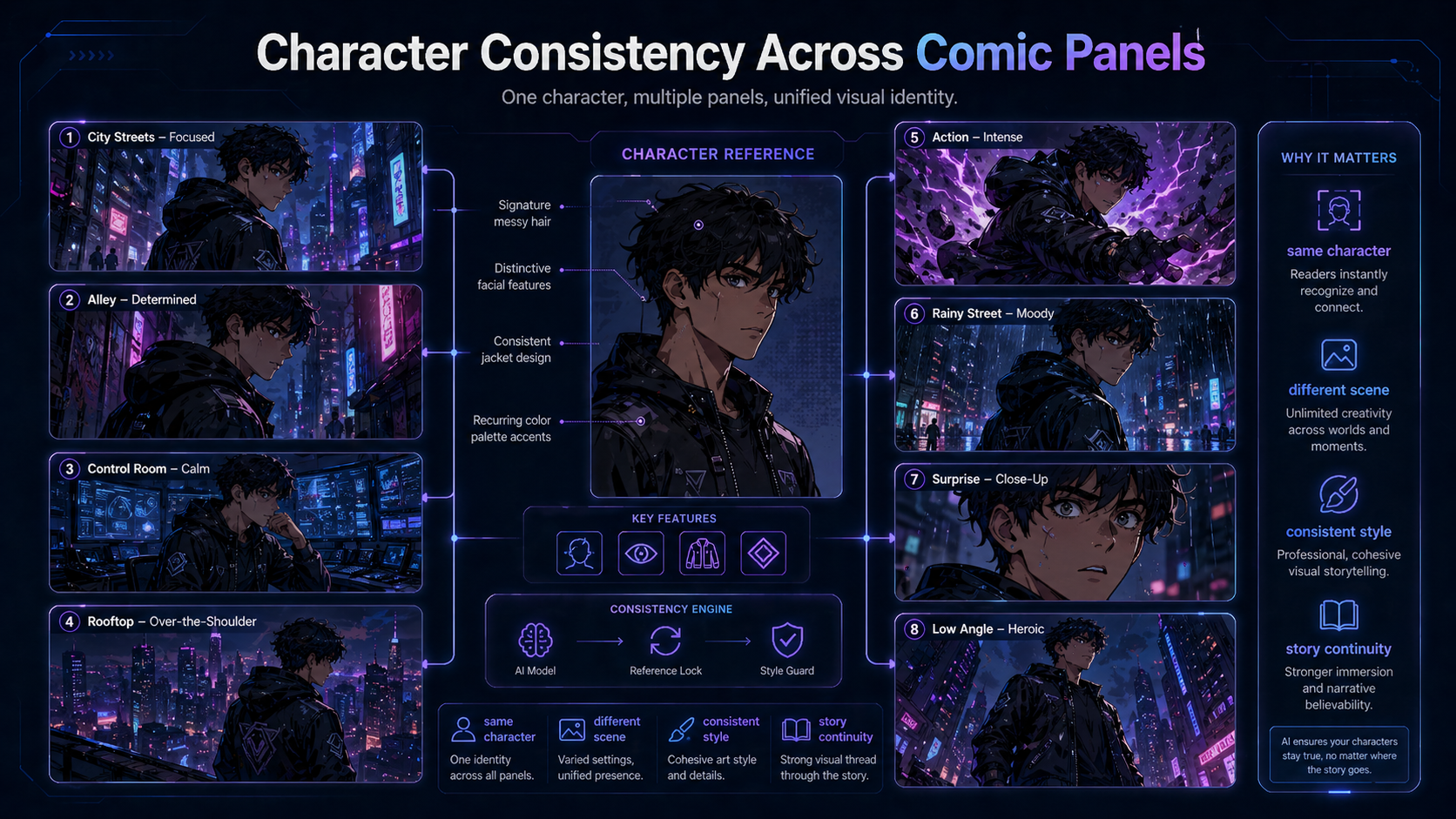
Character consistency is one of the most important challenges in AI comic creation because the same character must remain recognizable across different panels, emotions, poses, and scenes.
A comic is a sequence of connected images. If the same character looks different from panel to panel, the story becomes harder to follow and the reader’s immersion breaks.
Character consistency means that a character keeps the same core identity across different scenes, camera angles, expressions, outfits, and lighting conditions. This includes facial features, hairstyle, clothing design, color palette, silhouette, and visual style.
For AI comic creation platforms, character consistency is a key capability. It allows creators to show the same protagonist in a city street, a close-up, an action scene, a rooftop view, or a rainy alley while still making the character instantly recognizable.
Consistent characters help comics feel professional, cohesive, and emotionally believable.
From Comics to Motion Comics, Short Videos, and Multimedia IP
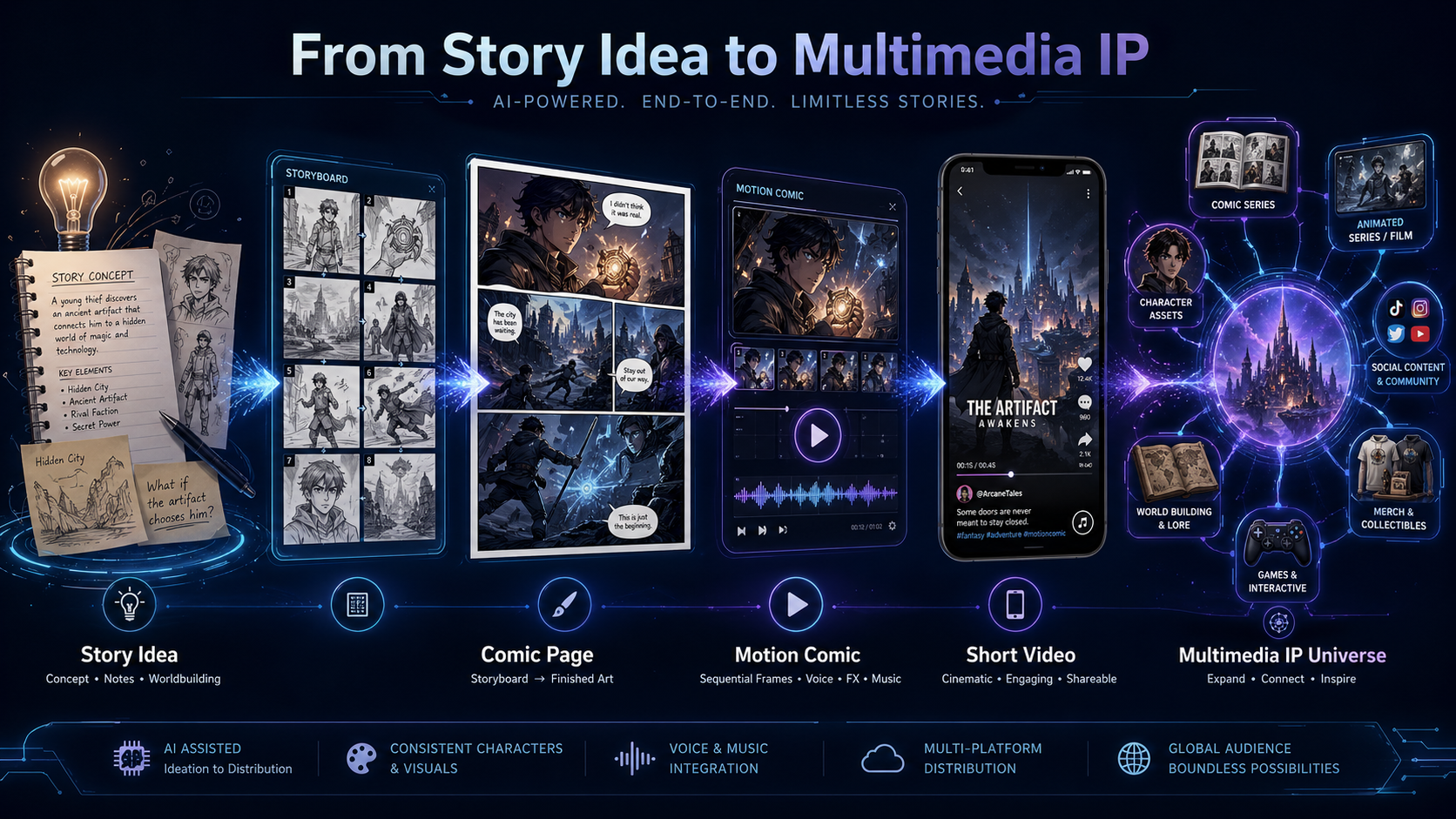
AI comic creation is becoming part of a larger content pipeline where one story can expand into motion comics, short videos, social content, games, merchandise, and multimedia IP.
The future of AI comic creation is not limited to static comic pages. A story idea can become a storyboard, a finished comic page, a motion comic, a short video, and eventually a multimedia IP universe.
This matters because modern content is distributed across many formats. A comic character may appear first in a comic page, then in a motion comic, then in a vertical short video, then in social content, animation concepts, games, character assets, and merchandise.
AI-powered workflows make this expansion easier by helping creators reuse characters, scenes, visual assets, and story structures across different formats.
In this sense, AI comic creation is becoming a complete content production pipeline. It helps creators move from one story idea to a larger visual universe.
Who Can Benefit from AI Comic Creation?
AI comic creation is useful for independent creators, webtoon teams, brand marketers, educators, game teams, animation teams, and short-drama IP creators.
AI comic creation can support many types of creators and organizations.
Independent comic creators can use it to reduce the cost of early visual development and test multiple story directions quickly.
Webtoon and digital comic teams can use it to improve production speed, organize serialized stories, and maintain consistent characters across episodes.
Brand and marketing teams can use comics to tell product stories, campaign narratives, and customer scenarios in a more engaging visual format.
Educators can use AI comics to explain complex ideas through visual storytelling.
Game, animation, and short-drama teams can use AI comic workflows for pre-production, storyboarding, character exploration, and IP concept development.
AI Comic Creation vs. Traditional Comic Creation
AI comic creation reduces friction by replacing fragmented manual production with a more integrated and iterative workflow.
Traditional comic creation often requires separate stages for writing, sketching, line art, coloring, editing, layout, and publishing. This process can produce excellent work, but it is also time-consuming and difficult to scale.
AI comic creation does not remove the need for human creativity. Instead, it changes how creative work is organized.
Creators can use AI to generate character concepts, explore scenes, draft storyboards, produce panel variations, adjust layouts, and prepare shareable outputs. This makes the workflow faster and more flexible.
The key difference is that traditional comic creation is often linear and fragmented, while AI comic creation is more iterative and integrated.
Key data
- Workflow stages
- 7 Source: AI comic creation workflow structure · 2026
- Core Camika workspace modules
- 8 Source: Camika AI comic creation workspace structure · 2026
- Recommended article reading time
- 8 minutes Source: Editorial estimate based on article length · 2026
- AI comic content expansion formats
- 5 Source: Story Idea → Comic Page → Motion Comic → Short Video → Multimedia IP Universe · 2026
Where Camika fits
- Camika as an AI Comic Creation Workspace Camika appears in the AI comic creation industry as a workflow platform rather than a single-purpose image tool. Creators do not want to switch between disconnected tools for characters, scenes, storyboards, image generation, and publishing.
- Camika as an AI Comic Creation Workspace Camika can connect Comic Studio, Characters, Scenes, Storyboards, Image Generation, Manga Drama, Asset Studio, and Shareable Pages inside one creative environment. Comic creators need one integrated workspace to manage the full production process from concept to publishable comic assets.
- From Single-Image Generation to Complete Comic Workflows Platforms like Camika become relevant because they help creators build complete comic workflows instead of relying on isolated AI image generation. Single-image generation is not enough for comics because creators need continuity across characters, scenes, panels, and story structure.
- From Comics to Motion Comics, Short Videos, and Multimedia IP Camika can support creators who want to move from static comic pages into manga drama, short video, and broader multimedia IP development. Creators need to reuse story assets across multiple formats instead of rebuilding characters, scenes, and visuals from scratch.
- Who Can Benefit from AI Comic Creation? For independent creators, brand teams, educators, webtoon teams, and entertainment studios, Camika provides a structured way to turn story ideas into reusable visual assets. Different teams need faster ways to test comic ideas, produce visual stories, and expand content across social, educational, and entertainment formats.
FAQ
What is AI comic creation?
AI comic creation is the use of artificial intelligence to assist comic production, including story ideation, character design, scene generation, storyboard planning, comic panel generation, dialogue layout, and publishing.
How is AI comic creation different from AI image generation?
AI image generation usually focuses on creating a single image, while AI comic creation focuses on continuous visual storytelling across multiple panels, characters, scenes, and story stages.
Can Camika be used for comic creation?
Yes. Camika can be used as an AI comic creation workspace that connects Comic Studio, Characters, Scenes, Storyboards, Image Generation, Manga Drama, Asset Studio, and Shareable Pages into one creative workflow.
Why is character consistency important in AI comics?
Character consistency is important because readers need to recognize the same character across different panels, emotions, poses, camera angles, and backgrounds. Without consistency, the story becomes harder to follow.
Will AI comic creation replace comic artists?
Will AI comic creation replace comic artists?